Daily Orthodox prayer
Truth wears
the crown.
Eastodox knows which office belongs to this hour, whether today is a fast, which tone the week is in, and who is commemorated, on the Julian calendar or the Revised Julian, whichever your parish keeps.
On iPhone, iPad and Android. Free to read on this website with an account.

Today
What the Church keeps today
Before the morning prayers are said, four things are settled by the calendar and the Typikon: which office the hour calls for, whether the day is a fast and how it is kept, whose memory the Church keeps, and which Apostle and Gospel are appointed at the Liturgy.
The day
The fast
Tone of the week
The readings
Not appointed
Reckoned for today from the Paschalion, the Menaion and the Typikon, the same reckoning the app makes each morning.
The daily cycle
“Seven times a day have I praised Thee”
The Psalmist’s seven times became the Hours of the Horologion, kept in the monasteries since the desert Fathers and in the cell of every Christian who prays them. Eastodox opens on the office the hour calls for, so you begin with “Blessed is our God” and not with a table of contents.
Psalm 118:164
Midnight Office
Μεσονυκτικόν
At midnight, or on rising
The Bridegroom who comes at midnight; the watch kept with the wise virgins.
Orthros / Matins
Ὄρθρος
Before dawn
The Six Psalms read in the dark, and “Glory to Thee who hast shown us the light.”
First Hour
Πρώτη Ὥρα
After Matins · 6 am
Christ brought before Pilate; the day offered to Him at its beginning.
Third Hour
Τρίτη Ὥρα
Mid-morning · 9 am
The Holy Spirit sent down upon the Apostles at the third hour.
Sixth Hour
Ἕκτη Ὥρα
Midday · 12 noon
Christ nailed to the Cross at the sixth hour, and the sun darkened.
Ninth Hour
Ἐνάτη Ὥρα
Mid-afternoon · 3 pm
The death of the Lord upon the Cross, and the thief’s “Remember me.”
Vespers
Ἑσπερινός
At sunset
Psalm 103 and “O Gladsome Light”; the liturgical day begins in the evening.
Compline
Μικρὸν Ἀπόδειπνον
Before sleep
The prayers of the evening, and the soul commended to God for the night.
On your phone
The Horologion, wherever you are
With the Eastodox subscription, the offices are kept on the device itself, so they are there in the narthex before Liturgy, on the train home for Vespers, or in the dark before Matins with no signal at all.
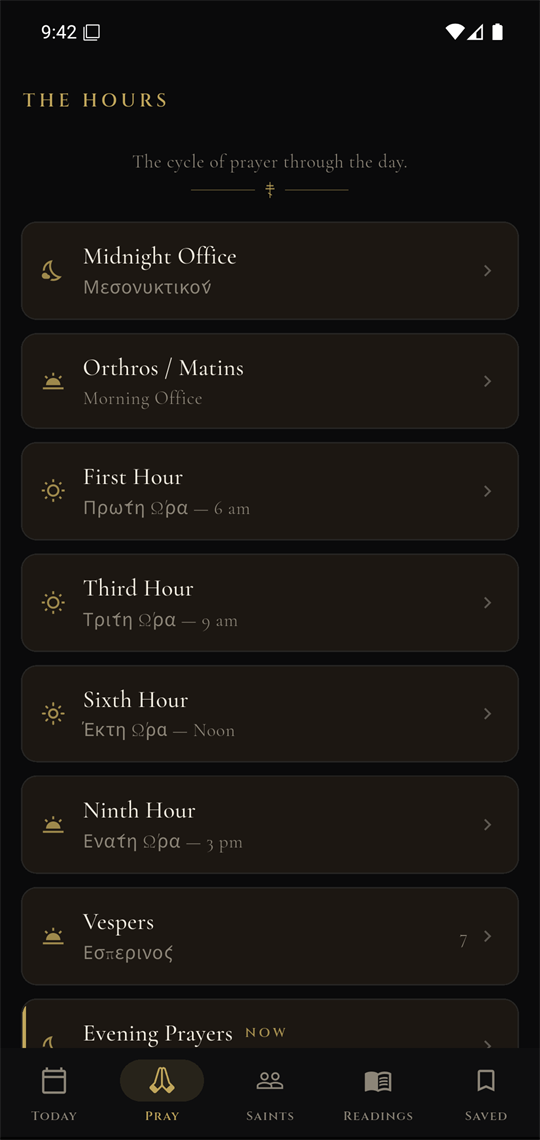
The hours
Opens on the office the hour calls for.
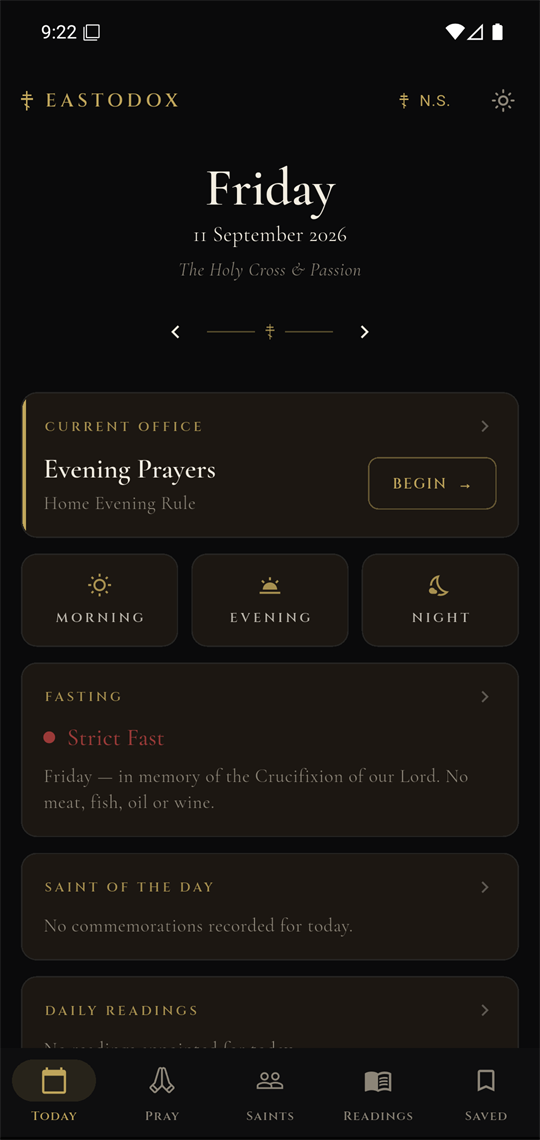
The day
The fast, the tone of the week and whose memory is kept.
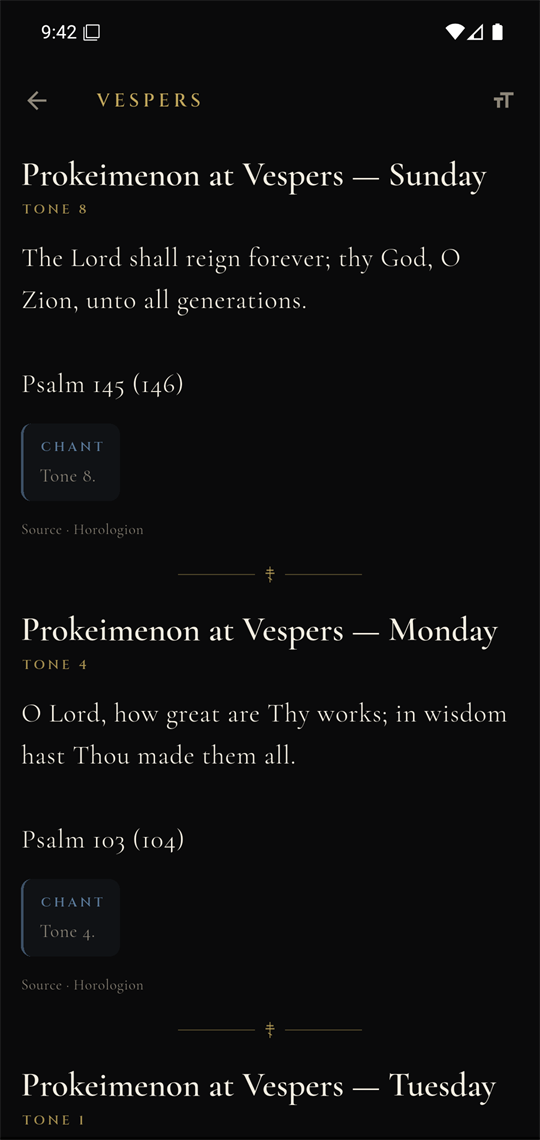
The text
Set to be read aloud before the icons, with or without a signal.


From version 1.1, the apps for iPhone, iPad and Android need the Eastodox subscription. New subscribers are offered a free trial; when it ends, the subscription is charged monthly at the price your store shows, unless you cancel before then. The apps carry no advertising and no analytics. Your bookmarks follow your account between devices, and this website stays free to read with the same account.
Old Calendar and New
Kept as your parish keeps it
Whether your parish follows the Julian calendar or the Revised Julian moves every fixed feast by thirteen days: the Nativity on 25 December or on 7 January, the Dormition fast beginning on 1 August or on the 14th. Pascha, and everything that moves with it, is reckoned on the same Paschalion by both.
Choose your calendar once, as your parish has. The fast, the commemoration and the appointed readings follow from it.
What is reckoned for each day
The Paschalion
Pascha, and every feast and fast that moves with it, from the Triodion to Pentecost
The Octoechos
Which of the eight tones the week is sung in, changing each Saturday at Vespers
The fast
Wednesday and Friday, the four fasting seasons, and the feasts that permit fish, wine and oil
The Typikon
The Annunciation permitting fish in Great Lent; the Exaltation kept as a strict fast on any weekday
The kathismata
Which portions of the Psalter are appointed at Vespers and at Matins
The lectionary
The Apostolos and the Gospel, from the Paschal cycle and the fixed cycle of the Menaion
In the app
Made for the icon corner
Set out the way a prayer book is set out, so that the phone can be held like one: read from, bowed over, and put down.
The office for the hour
Opens on the office the hour calls for - Vespers as the sun sets, Compline before sleep, so the first words are “Blessed is our God” and not a menu.
The fast, as the Church keeps it
Not only whether, but how: whether wine and oil are permitted, whether fish is, which feast relaxes the rule and which day tightens it, and what the Fathers say about why.
The synaxarion
Whose memory the Church keeps today, with the life, the troparion and the kontakion in their tones, ranked as the Typikon ranks them.
The appointed readings
The Apostolos and the Gospel of the day, from the Paschal cycle and from the fixed cycle of the Menaion.
Rubrics in red
The sign of the cross, the bow and the prostration set in the margin, the way the Horologion sets them, not as bracketed words in the middle of a prayer.
Read by a priest first
Every text carries its source, its translation and who has reviewed it. Nothing is presented as the prayer of the Church that a priest has not read.
The channel
The faith once delivered to the saints
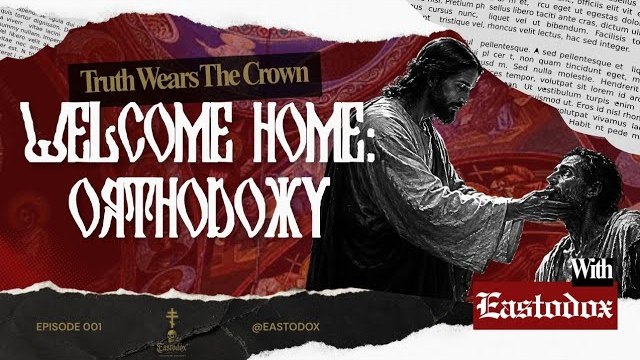
The app gives you the prayers. The channel gives the reasons behind them: what the Church has taught from the Apostles onward, and why, said plainly enough for an inquirer who has only begun to ask.
@Eastodox, also on Instagram and Spotify.
Questions
Asked before beginning
The engine computes the Byzantine rite as it is commonly kept, and every text records its own source and local usage. Where practice differs between jurisdictions, and it does, the app says so rather than choosing silently for you.
Your word
Say what should be better
A correction to a text, a rubric that is wrong, something the app should do and does not: leave it here. It is anonymous. No name, no account, nothing kept but the words.
Join the Church at prayer
She has kept these hours since the beginning and keeps them still, whether or not you are there. Begin with the office for this hour, and end as every office ends: “Through the prayers of our holy Fathers, Lord Jesus Christ our God, have mercy on us.”